
Does Your Small Business Really Need a Color Printer?
When shopping for a new office printer, many small business owners start with one assumption:"We need color because our logo is in color."
It's a reasonable thought, but it often leads businesses to spend far more than necessary on printing.
The reality is that most small and medium-sized businesses print overwhelmingly in black and white. Invoices, purchase orders, work orders, packing slips, contracts, internal documents, and reports rarely require color. Yet many organizations purchase and maintain a color multifunction printer because they occasionally need to print a proposal, presentation, or marketing piece.
Over time, that decision can become surprisingly expensive.
The Hidden Cost of Color
Today's color printers are more affordable than ever, but the ongoing costs tell a different story.
Color devices require additional toner cartridges, more complex maintenance, and often higher service costs. Even businesses that rarely print in color are still supporting a more expensive piece of equipment every day.
When the vast majority of your print volume is black and white, paying a premium for color capabilities that are used only occasionally doesn't always make financial sense.
A Smarter Alternative
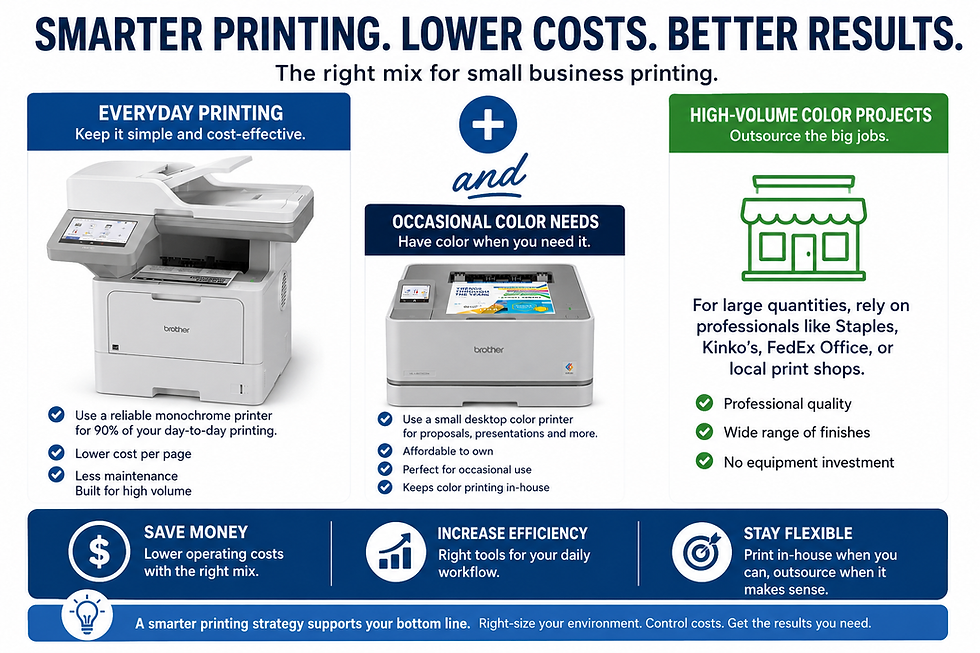
For many SMBs, the most cost-effective setup is actually two devices:
A business-class monochrome printer or multifunction device for everyday printing.
A small desktop color printer for occasional color needs.
This approach allows businesses to keep their day-to-day printing costs low while still having access to color when needed.
Your staff can print invoices, reports, and operational documents on the monochrome device, while proposals, presentations, and customer-facing materials can be printed on the color printer as required.
The result is lower operating costs without sacrificing flexibility.
What About Larger Color Jobs?
This is where many businesses make the mistake of sizing their entire print environment around a handful of annual projects.
Let's say your company needs to produce 500 full-color brochures for a trade show, customer event, or marketing campaign.
That doesn't mean you need to own a printer optimized for those jobs year-round.
Instead, outsource those occasional high-volume color projects to a local print provider such as Staples Print Services, FedEx Office, or another commercial print shop.
Professional print providers can often produce higher-quality color output on better paper stocks at a lower overall cost than printing the same project in-house.
More importantly, you avoid carrying the ongoing expense of a larger color printer simply to accommodate a few special projects each year.
Focus on Your Actual Printing Habits
When evaluating your next printer purchase, ask yourself:
What percentage of our monthly printing is actually color?
How often do we print customer-facing marketing materials?
Could larger color projects be outsourced more economically?
Are we buying a printer for our daily needs or our occasional needs?
For many businesses, the answers point toward a simple conclusion:
A reliable monochrome office printer paired with a small desktop color printer provides the best balance of cost, performance, and flexibility.
And when those larger color jobs come along, your local print shop can handle them quickly and professionally without adding thousands of dollars to your long-term printing costs.
Sometimes the smartest printing strategy isn't buying more printer—it's buying the right printer and outsourcing the exceptions.


Comments